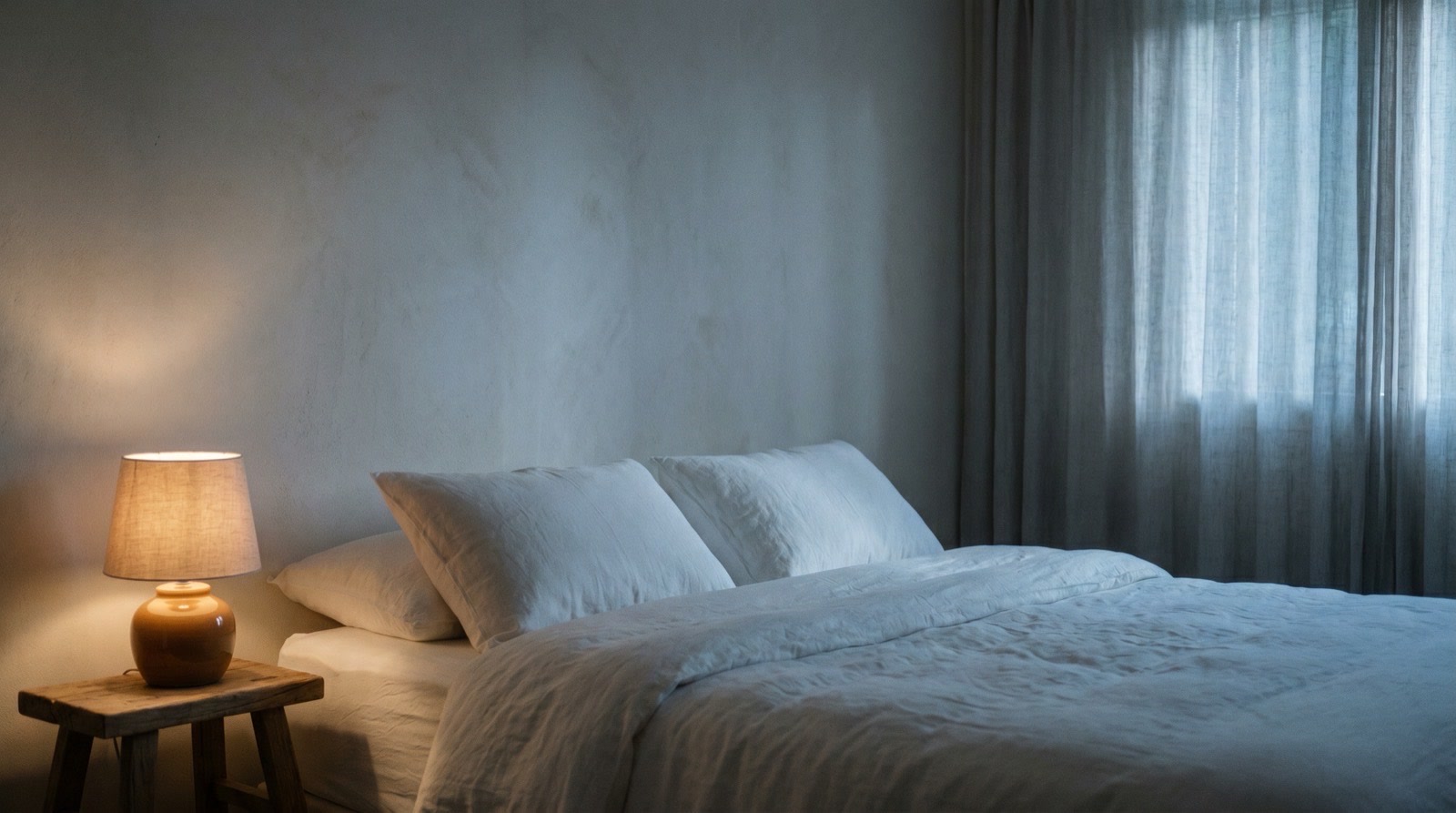
- The ideal bedroom temperature for most adults is 65–68°F (18–20°C) — the range that supports the core body temperature decline required to initiate and maintain sleep.
- Your core temperature must drop 1–2°F before sleep onset. A warm room slows or blocks that decline and delays how quickly you fall asleep.
- An analysis of 3.75 million nights of objective sleep data found sleep efficiency decreases measurably with each degree above the optimal range.
- During REM sleep, your body stops thermoregulating entirely. Whatever your room temperature is, that becomes your brain temperature — which is why heat destroys REM.
- Older adults sleep best at a slightly warmer 68–75°F (20–24°C) as thermoregulatory capacity declines with age.
- A warm bath 1–2 hours before bed paradoxically improves sleep by accelerating the same core cooling your body needs at sleep onset.
- Use the calculator below to find your personalized target range.
Temperature is among the most powerful environmental variables controlling your sleep — more controllable than light, more quantifiable than stress, and more immediately actionable than any supplement. Sleep scientists keep arriving at the same answer from independent study designs: a bedroom of 65–68°F (18–20°C) is where most healthy adults sleep best. The question worth understanding is why. Because once you understand the mechanism, the practical decisions — how cold is too cold, whether a fan counts, whether the warm bath trick is real — all follow logically.
1. The Number: 65–68°F (18–20°C)
The 65–68°F recommendation is not arbitrary. It maps onto a physiological constraint: your core body temperature follows a circadian rhythm, peaking in the late afternoon, then declining through the evening. Sleep onset does not trigger that decline — the decline triggers sleep. Thermoregulatory changes in the hour before sleep onset — specifically a core temperature drop of 1–2°F — are part of the biological machinery that switches the brain from wakefulness to sleep. A bedroom too warm slows that transition. A bedroom in the 65–68°F range allows it.
Our sleep temperature calculator uses these thresholds alongside your age and typical sleep profile to output a personalized target range. The number it produces for most adults will land in this window — because the constraint is biological, not cultural.
2. Why Your Core Temperature Must Fall to Sleep
The mechanism is peripheral vasodilation. As your circadian clock moves into the evening phase, the body begins routing blood toward the extremities — hands, feet, face — to radiate heat outward. Core temperature falls as the periphery warms. This is why your hands and feet often feel warmer than usual in the half-hour before you fall asleep. That warmth is heat leaving your body, not accumulating in it.
The distal-to-proximal skin temperature gradient — the difference between the temperature of your extremities and your trunk — is one of the most reliable predictors of how quickly you will fall asleep. Raymann and colleagues showed that manipulating skin temperature within the comfortable thermoneutral zone by changes as small as 0.4°C reliably shifted sleep onset latency in healthy adults. The sleeping brain is exquisitely sensitive to these peripheral signals.
A bedroom at 65–68°F creates the right thermal gradient: cool enough that the air acts as a heat sink, pulling warmth away from the skin surface and accelerating core cooling. A bedroom at 75°F blunts that gradient. A bedroom at 58°F may overcorrect it, triggering cold-defense vasoconstriction that delays sleep onset from the other direction. Your sleep latency data — the time between lights out and sleep onset — is the most sensitive downstream indicator of whether your room temperature is working for or against you.
3. What Heat Does to Your Sleep Architecture
The most consequential effect of a warm bedroom is not on how quickly you fall asleep — it is on what happens to your sleep stages once you are there.
A 2012 systematic review of the effects of thermal environment on sleep found that in real-life conditions — where people use bedding and nightwear — heat exposure increases wakefulness and decreases both slow-wave sleep and REM sleep. Both are stages your brain cannot afford to lose. Slow-wave sleep (SWS) is when physical restoration happens: growth hormone release, tissue repair, immune consolidation. REM is when the brain processes emotional memory, clears metabolic waste via the glymphatic system, and consolidates the day’s learning.
REM sleep is disproportionately vulnerable for a specific reason: during REM, your hypothalamus suspends active thermoregulation. You stop sweating. You stop shivering. Your body temperature becomes a near-passive function of ambient room temperature. In a room at 75°F, your brain runs warmer during REM than it should, and the nervous system responds with an arousal — typically a brief waking you do not remember, but one that fragments the REM episode and resets the stage. In a room at 65°F, the REM architecture completes undisturbed.
This matters most in the second half of the night. Sleep cycles are front-loaded with SWS and back-loaded with REM. The deepest, longest REM episodes — the ones most critical for emotional regulation and memory consolidation — occur in the final 90–120 minutes before your alarm. An overheated room is most damaging precisely when sleep architecture needs the most protection.
4. The 3.75 Million Nights Dataset
Individual polysomnography studies measure tens or hundreds of subjects in controlled laboratory conditions. They are rigorous but artificial. A different class of evidence comes from large-scale observational data collected in real homes.
An analysis of over 3.75 million nights of objective sleep data found that for every 1°F increase in bedroom temperature above the optimal range, sleep efficiency declined, and participants experienced longer sleep onset latency, shorter total sleep time, and more wake time after sleep onset. The dose-response relationship held across the sample: the effect was not a threshold but a gradient. Every degree above the optimal range cost something. The study confirmed what smaller controlled trials had suggested: there is no “good enough” at 72°F. The penalty is real, it is measurable, and it compounds across nights.
If you have been tracking your sleep hygiene score, bedroom temperature is one of the variables most likely to explain persistent low scores that resist other interventions. It is also one of the most underrated, because the effect is invisible — you do not feel the REM fragmentation in real time. You feel it as a groggy morning, reduced concentration by noon, and a pull toward caffeine that begins earlier than it should. Our sleep score calculator treats bedroom temperature as a modifiable variable with one of the highest effect sizes in the hygiene stack.
5. The Exception: Older Adults
Thermoregulatory capacity declines with age. Older adults produce less metabolic heat, have reduced peripheral blood flow responsiveness, and are less sensitive to the skin temperature signals that trigger the sleep-onset cascade. This does not mean they need a warmer room because they “feel cold” — it means the biology of their thermoregulatory system operates at a different setpoint.
A longitudinal study monitoring 50 community-dwelling older adults (average age 79) across 18 months found that sleep was most efficient when nighttime ambient temperature was between 20–25°C (68–77°F), with a clinically relevant 5–10% drop in sleep efficiency when temperature exceeded this range by 5°C. The optimal zone for older adults is therefore shifted warmer relative to the 65–68°F recommendation for younger and middle-aged adults.
This is also why the standard advice — “keep your room at 65°F” — does not universally apply. A 75-year-old may genuinely sleep better at 70°F than at 65°F. The circadian rhythm calculator accounts for age-related phase shifts when generating sleep timing recommendations, and the same logic applies to temperature: the optimal target moves as the thermoregulatory system ages.
6. The Warm Bath Paradox
Here is a counterintuitive finding that has now been replicated across multiple meta-analyses: a warm bath at approximately 104°F (40°C), taken 1–2 hours before your intended sleep time, measurably improves sleep onset latency and subjective sleep quality. This seems wrong — you are adding heat to a system that needs to cool down.
The mechanism explains the paradox. The warm water forces aggressive peripheral vasodilation: blood rushes to the skin surface, your hands and face flush, and your extremities become excellent radiators. When you exit the bath, that peripheral blood flow continues for 30–60 minutes, radiating accumulated heat into the cooler air of your bedroom. The result is an accelerated core temperature decline — faster than the body would achieve through natural circadian cooling alone. You have used heat to produce cold, at a rate that mimics and amplifies the thermoregulatory signal your brain is waiting for.
The timing window matters: the bath needs to occur 1–2 hours before bed, not immediately before. Immediately before bed, your core is still elevated and the post-bath cooling is incomplete. At 90 minutes out, the core temperature decline aligns with the circadian nadir and the melatonin rise. Our melatonin timing calculator can help you identify that window precisely based on your chronotype and typical sleep schedule.
7. Find Your Target Temperature Range
The 65–68°F consensus is a starting point for healthy adults, not a universal prescription. Use the tool below to narrow it based on your profile, or go to the full sleep temperature calculator for a more detailed output.
Sleep Temperature Finder
Three questions. One recommended range.
The Bottom Line
Temperature is not a comfort variable — it is a biological control lever. The 65–68°F (18–20°C) range exists because sleep onset is thermoregulatory, REM sleep is thermoregulatory, and the sleeping brain is genuinely at the mercy of ambient temperature during its most critical phases. The 3.75 million night dataset confirms that the dose-response relationship is real: every degree above the optimal range costs measurable sleep efficiency. Every degree below roughly 62°F risks the opposite problem.
The practical prescription is simpler than most sleep interventions: set your thermostat to 66–68°F before bed, use a fan if you cannot air-condition, take a warm bath 90 minutes out if you want to accelerate onset, and give the room 20 minutes to pre-cool before you get in. If you are over 65, bump the target 3–4 degrees warmer. That is the whole protocol. The science is complicated; the application is not.
Tools Mentioned in This Article
References
- Okamoto-Mizuno, K., & Mizuno, K. (2012). Effects of thermal environment on sleep and circadian rhythm. Journal of Physiological Anthropology, 31(1), 14. PubMed
- Havas, M. et al. (2020). Higher Bedroom Temperature Associated With Poorer Sleep: Data From Over 3.75 Million Nights. SLEEP, 43(Supplement_1), A464. Oxford Academic
- Raymann, R. J. E. M., Swaab, D. F., & Van Someren, E. J. W. (2008). Diminished Capability to Recognize the Optimal Temperature for Sleep Initiation May Contribute to Poor Sleep in Elderly People. Sleep, 31(9), 1301–1309. PMC
- Baniassadi, A. et al. (2023). Nighttime Ambient Temperature and Sleep in Community-Dwelling Older Adults. Science of the Total Environment. PMC
- Kräuchi, K. (2007). Thermoregulatory changes around the time of sleep onset. Sleep Medicine Reviews, 11(6), 429–437. PubMed
- Llorens-Martín, M. et al. (2023). Association between circadian skin temperature rhythms and actigraphic sleep measures in real-life settings. Journal of Clinical Sleep Medicine. JCSM
Medical disclaimer: This article is for informational and educational purposes only. It is not a substitute for professional medical advice, diagnosis, or treatment. Always seek the advice of a qualified healthcare provider with any questions you may have regarding a medical condition or sleep disorder. Never disregard professional medical advice or delay seeking it because of something you have read on this website.