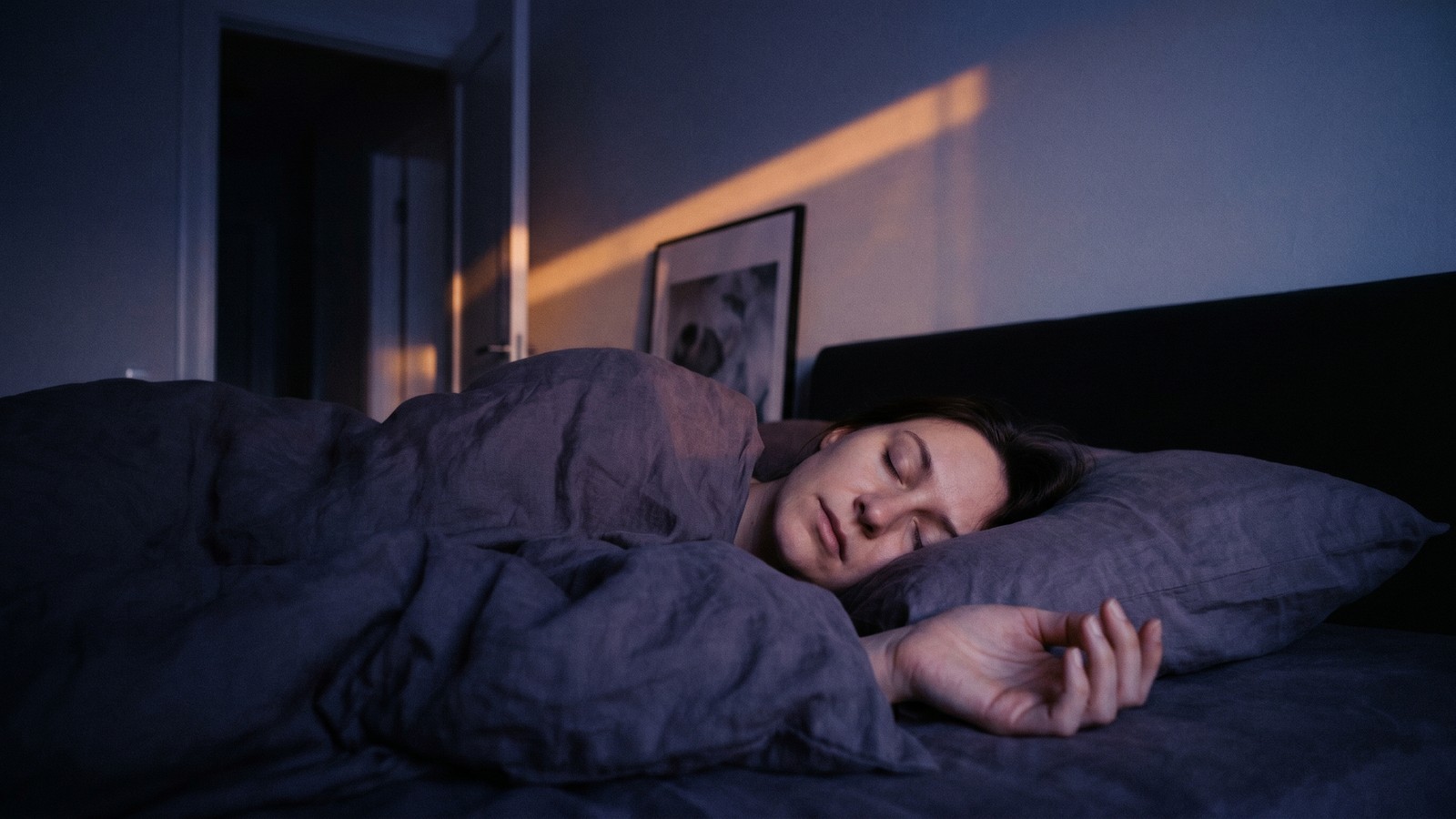
- Hypnagogia is the transitional brain state between waking and sleeping. 80.2% of people experience it, but almost no one deliberately uses it.
- Your brain descends a frequency staircase during sleep onset: beta → alpha → theta → delta. Each step has a name, a number, and a function.
- Thomas Edison and Salvador Dalí both used this threshold state systematically for creativity. MIT has since built a device to do the same thing — and found it triples creative problem-solving.
- Binaural beats guide the brain through this staircase by playing two slightly different tones in each ear, creating a perceived beat at the difference frequency.
- Caffeine delays theta-wave onset, which is why timing matters for both evening sleep and afternoon creative naps.
- Hypnagogic hallucinations (seeing faces, hearing sounds) are experienced by up to 70% of people and are almost always harmless.
- The optimal nap window for accessing hypnagogia without grogginess is 10–20 minutes.
There is a cultural moment happening around liminal spaces. You know the type: the empty swimming pool at 3am, the fluorescent-lit mall corridor after closing, the parking garage that seems to go on a floor too long. The aesthetic has been building online for years, and recent cinema has pushed it fully into the mainstream conversation.
But here is something most people do not know: there is a liminal space you visit every single night. It is not a hallway. It is not uncanny or eerie. It is the seconds-to-minutes threshold between waking and sleeping — a state with its own neuroscience, a measurable frequency signature, and a history of deliberate exploitation by some of the most creative minds in history. It even has a name.
1. What Is Hypnagogia? The Science of Sleep Onset
The state is called hypnagogia. The word comes from the Greek: hypnos (sleep) and agogos (conductor or leader) — the conductor leading you into sleep. The term was coined by the French physician Alfred Maury in 1848, though the state itself has been described since antiquity.
Hypnagogia is not falling asleep. It is the transition — the liminal phase between wakefulness and sleep onset, where consciousness begins to fragment and the brain starts its nightly frequency descent. During hypnagogia, brain activity slows, muscles relax, heart rate lowers, and the protective filtering of the conscious mind starts to dissolve. You become susceptible to dreamlike imagery, sounds that are not there, and sensations of falling or floating that feel entirely real in the moment.
The brain does not switch off like a light. Research shows it oscillates — swinging back and forth between wakefulness and sleep onset, sometimes multiple times within seconds, like a pendulum losing energy. This is why hypnagogic experiences feel so vivid and then so difficult to recall: each brief dip into sleep produces imagery, but waking consciousness cannot reliably hold onto it.
The hypnagogic state involves a complex mix of phenomenological features including perceptual, cognitive, and affective elements that distinguish it from both waking and dreaming — and it is far more common than most people realize. A 2023 study published in Consciousness and Cognition, surveying 4,456 participants, found that 80.2% reported hypnagogic experiences — most often kinesthetic (the sensation of movement or falling) and visual, with auditory experiences less frequent. This is not an unusual neurological quirk. It is the majority human experience of going to sleep.
The corresponding outbound state — the transition from sleep back to wakefulness — is called hypnopompia. Together they form the liminal phases of sleep, bracketing the night on either side. Use the sleep cycle calculator to understand where these transitions fall within your broader nightly architecture and how they relate to REM and slow-wave sleep.
2. The Creative Liminal Space: Edison, Dalí, and MIT
Thomas Edison did not sleep the way most people sleep. He was famously dismissive of extended sleep as wasteful. But there was one state he cultivated deliberately: hypnagogia.
Edison’s method was this. He would sit in a chair with steel balls held loosely in his hands, positioned over a hard floor or a metal plate. As he drifted toward sleep and his muscles began their normal relaxation response, his grip would loosen, the balls would drop, and the clang would wake him. The purpose was to catch himself at the exact moment of threshold consciousness — before full sleep, after the inner critic had quieted — and harvest whatever ideas or images had surfaced.
Salvador Dalí used an almost identical technique, substituting a heavy key and a ceramic plate. He called it “sleeping with a key” and credited it with some of the imagery in his most famous paintings. Neither man was being eccentric. Both were systematically targeting a specific, measurable brain state.
Modern researchers have built technology to do exactly the same thing. The Dormio device, developed at MIT’s Media Lab, is a wrist-worn system that monitors for the muscle relaxation that accompanies hypnagogic sleep onset. When the device detects the transition, it plays an audio prompt to guide the user’s hypnagogic imagery — a technique called targeted dream incubation. In studies using the device, participants who stayed in the hypnagogic state were approximately three times more likely to find a sudden solution to a creative problem compared with those who stayed fully awake or fell into deeper sleep.
The creative sweet spot is specific. Research points to a cocktail of moderate alpha brain waves — the drowsiness marker — and low delta waves in the very earliest stage of sleep depth. This combination suppresses the inner critic, loosens associative constraints, and allows different brain regions to communicate more freely than they do during focused waking thought. It is not a mystical state. It has a frequency signature.
And that frequency signature is exactly what The Sleep Math is built on.
3. The Frequency Math: Your Brain’s Nightly Staircase
Your brain generates electrical activity measurable in cycles per second — hertz (Hz). As you move from waking to sleep, that activity follows a predictable frequency descent through four distinct bands. Each step has a name, a number, and a function.
Binaural beats work by exploiting a quirk of auditory processing. If you play a 200 Hz tone in one ear and a 206 Hz tone in the other, your brain does not hear two separate tones. It perceives a third tone — a “beat” — at the difference frequency: 6 Hz, squarely in the theta range. This is an auditory illusion generated entirely by the brain. The beat does not exist in the air; it exists in the neural processing of two separate signals. It requires stereo channel separation. Speakers produce a mixed signal before it reaches your ears; the binaural effect only functions with headphones.
Research has found that binaural beats calibrated to the theta range (around 6 Hz) can induce a meditative state associated with the early hypnagogic transition. Beats in the delta range (around 3 Hz) have been shown to increase the duration of stage 3 deep sleep — the most physically restorative phase. Alpha-range beats (around 10 Hz) support the relaxed-aware state that precedes theta onset.
The Sleep Math’s long-form audio content is engineered to guide the brain through this exact staircase: easing into alpha, descending through theta to support the hypnagogic transition, and settling into delta for deep restorative sleep. This is not a playlist of relaxing sounds. It is frequency-targeted audio designed around the architecture of healthy sleep onset.
4. How to Use Your Liminal Space
Once you understand the frequency staircase, hypnagogia becomes something you can navigate deliberately rather than simply fall through.
The Edison Nap
To access the hypnagogic theta state for creativity, you want to catch it and wake yourself from it before descending into deeper sleep. Sit upright in a chair — not lying down, which risks missing the drop signal — and hold a small object loosely in your hand: a pen, a ball, a set of keys. Think about the problem you want to work on for 30–60 seconds before closing your eyes. Then let yourself drift. When the object drops, write down immediately whatever was in your mind. Images, fragments, words, nonsense — all of it. The inner critic is still partially offline. It will not stay that way.
This works best in the early afternoon, when sleep pressure is building and a brief alpha-theta dip is biologically natural. Avoid it in the 2–3 hours before your target bedtime, as it reduces the sleep pressure that drives efficient nighttime sleep onset.
Optimal nap length
If you want the creative benefits of hypnagogia without waking up groggy, keep naps to 10–20 minutes. This window captures stage 1 and the beginning of stage 2 NREM without descending into the slow-wave sleep that produces sleep inertia on waking. The nap calculator times this precisely relative to your wake time and intended sleep window, so you land in theta without overshooting into delta. It's the same duration cutoff that shows up across the broader nap research, where a 30-minute nap has been shown to produce measurable grogginess that a 10-minute nap does not.
Caffeine and the theta threshold
Caffeine works by blocking adenosine receptors. Adenosine is the chemical that accumulates during waking hours and drives sleep pressure — the same pressure that facilitates the alpha-to-theta transition. Block adenosine and you delay theta-wave onset. This is useful for maintaining alertness but counterproductive if you want to fall asleep efficiently at night or access hypnagogia during an afternoon session. The caffeine cutoff calculator accounts for body weight, metabolism, and chronotype to give you a personal curfew timed to your theta onset window.
Chronotype and the hypnagogic window
Not everyone descends the frequency staircase at the same pace or the same time of day. Night owls tend to have a longer, more gradual alpha-to-theta transition — a wider hypnagogic window that opens later in the evening. Morning types drop into theta faster and earlier. Your chronotype shapes the timing and character of your own liminal space. The chronotype quiz identifies whether you are a lion, bear, wolf, or dolphin — and what that tells you about when your natural hypnagogic window opens.
Environment
A dark room and cool temperature (65–68°F) support the core body temperature drop that facilitates sleep onset and the alpha-to-theta shift. For binaural beats, over-ear headphones provide better channel separation than earbuds and are worth the investment if you plan to use frequency-targeted audio regularly. Track how long it takes you to reach sleep onset with the sleep latency calculator — it is a useful baseline before and after making changes to your pre-sleep environment.
5. When the Liminal Space Goes Wrong
Most hypnagogic experiences are benign. But for some people, the threshold between waking and sleeping produces experiences that are frightening or confusing.
Hypnagogic hallucinations are the most common presentation: seeing faces, geometric patterns, or complex scenes; hearing your name called when no one is there; or experiencing vivid tactile sensations like being touched or falling. These occur because the brain’s visual and auditory cortices begin producing content before the prefrontal cortex has fully disengaged to provide reality-checking. Up to 70% of people experience hypnagogic hallucinations at some point, and in the vast majority of cases they are completely harmless — a feature of the threshold state rather than a symptom of anything wrong.
Sleep paralysis is a more alarming variant. This is the sensation of being awake but unable to move, sometimes accompanied by a felt presence in the room or pressure on the chest. It occurs when the muscle atonia that normally protects you from acting out dreams extends into a moment of partial wakefulness. Sleep paralysis episodes typically last seconds to a few minutes and are not medically dangerous, though they can be deeply frightening — particularly when combined with hypnagogic visual experiences.
When to see a doctor: if hypnagogic hallucinations occur frequently outside the sleep-onset window — during the day, while fully awake — or if they are accompanied by excessive daytime sleepiness and sudden muscle weakness triggered by emotion (cataplexy), these patterns can indicate narcolepsy. Acting out dreams during sleep (rather than being paralyzed) suggests REM sleep behavior disorder. Both warrant medical evaluation. Use the sleep apnea risk calculator as a first-pass screening tool if you are experiencing broader sleep disruption symptoms alongside the above.
The Bottom Line
The liminal space conversation is everywhere right now because there is something universally resonant about in-between places — the sense of existing in a state that is not quite one thing or another, between what was and what comes next.
Sleep has always been the original liminal space. Every night, you pass through a state where the brain has not yet committed to unconsciousness, where the inner critic is partially offline, where the frequency of your thoughts is measurably different from everything on either side of it. That state has a name. It has a neuroscience. It has a 174-year research history and a frequency you can listen to, time, and deliberately navigate.
The math of sleep starts at the threshold. You do not need to noclip through a wall to find it. You just need to close your eyes and know what is happening when you do. Start with the sleep cycle calculator to understand your full nightly architecture, or go straight to the nap calculator to plan your first deliberate descent.
Tools Mentioned in This Article
References
- Ghibellini, G., & Sforza, E. (2023). The hypnagogic state: A brief update. Journal of Sleep Research, 32(1). PubMed
- Hypnagogic experiences: prevalence, modalities, and relationship to sleep quality. Consciousness and Cognition (2023). ScienceDirect
- Konkoly, K. R., et al. (2021). Real-time dialogue between experimenters and dreamers during REM sleep. Current Biology, 31(7), 1417–1427. Cell Press
- MIT News (2021). Dream incubation device Dormio. MIT News
- Sleep Foundation. Binaural beats and sleep. sleepfoundation.org
- Cleveland Clinic. Hypnagogic hallucinations: causes, symptoms & treatment. clevelandclinic.org
Medical disclaimer: This article is for informational and educational purposes only. It is not a substitute for professional medical advice, diagnosis, or treatment. Always seek the advice of a qualified healthcare provider with any questions you may have regarding a medical condition or sleep disorder. Never disregard professional medical advice or delay seeking it because of something you have read on this website.